100% free · No sign-up · Photo stays on your device
Face shape detector: what shape is your face?
Upload a selfie and the free face shape detector finds your face shape in seconds, from oval and round to heart and diamond. Each face shape result comes with haircuts and glasses frames that flatter it.
Loading face analyzer…
Preparing AI model (first load may take a few seconds)
How the face shape detector works
Detection uses Google's MediaPipe Face Landmarker, running on your device.
- 1
Upload a selfie
Take a clear front-facing photo, or use your camera. Pull your hair back and remove glasses if you can.
- 2
Landmarks are measured
The detector maps 478 facial landmarks in your browser and measures face length, forehead, cheekbones and jaw.
- 3
Get your face shape
See the closest of seven face shapes, with haircuts and glasses frames that suit your proportions.
7 face shapes the detector recognizes
Find yours below, with the haircuts and frames that tend to suit it.
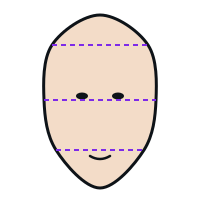
Oval
Oval faces are longer than they are wide, with a gently rounded jawline. Considered the most versatile face shape — most hairstyles and glasses look great on you.
Haircuts: Layered cuts, Beach waves, Long bob (lob)
Glasses: Wayfarer frames, Cat-eye glasses
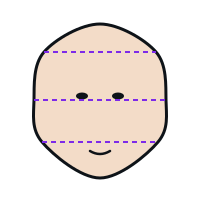
Round
Round faces have soft, curved angles with width and length roughly equal. The goal is to add length and definition to elongate the face.
Haircuts: Long layers, Side part, Angled bob
Glasses: Rectangular frames, Wayfarer frames
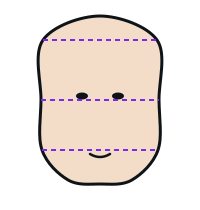
Square
Square faces have a strong, angular jawline with similar width across the forehead, cheekbones, and jaw. Softening the angles is usually the goal.
Haircuts: Soft layers, Side-swept bangs, Long waves
Glasses: Round frames, Oval frames
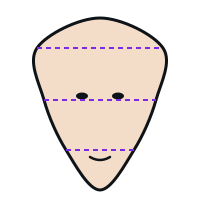
Heart
Heart-shaped faces have a wide forehead and cheekbones that taper to a narrow, pointed chin. Balancing the width of the forehead with the narrow chin is key.
Haircuts: Chin-length bob, Side part with waves, Long layers starting below the chin
Glasses: Round frames, Oval frames
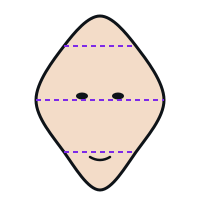
Diamond
Diamond faces have narrow forehead and jawlines with wide cheekbones — the rarest face shape. The goal is to soften the cheekbones and balance the narrow chin.
Haircuts: Shoulder-length layers, Side-swept bangs, Curly / voluminous styles
Glasses: Oval frames, Cat-eye glasses
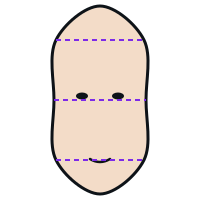
Oblong
Oblong (rectangle) faces are significantly longer than they are wide, with a long straight cheek line. Adding width and shortening the face visually creates balance.
Haircuts: Chin-length bob, Blunt bangs, Wide curls / waves
Glasses: Round frames, Oversized square frames
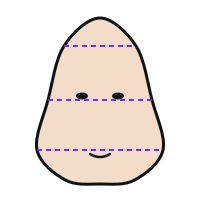
Triangle
Triangle (pear-shaped) faces have a narrow forehead that widens through the cheeks and jaw. Adding width to the forehead balances the stronger jawline.
Haircuts: Side-swept bangs, Layers with volume at the temples, Pixie cut
Glasses: Cat-eye glasses, Browline frames
Face shape detector rules for each shape
The detector divides face length, forehead width and jaw width by cheekbone width, and measures the angle at the chin between lines to each jaw corner. Rules are checked in this order; the first one that fits is your result.
| Order | Rule the detector applies | |
|---|---|---|
| 1Oblong | Oblong | Face length more than 1.6× cheekbone width, with forehead and jaw both wider than 75% of the cheekbones. |
| 2Heart | Heart | Forehead at least 90% of cheekbone width and jaw narrower than 75%. |
| 3Triangle | Triangle | Forehead narrower than 80% of cheekbone width and jaw at least 90%. |
| 4Diamond | Diamond | Forehead and jaw both narrower than 85% of cheekbone width. |
| 5Round | Round | Face length under 1.25× cheekbone width and a soft chin angle above 70°. |
| 6Square | Square | Face length under 1.35× cheekbone width, a chin angle of 70° or less and a jaw wider than 85% of the cheekbones. |
| 7Oval | Oval | Everything else: longer than wide, with forehead, cheekbones and jaw in balance. |
Check your face shape by hand
No photo handy? Four measurements with a soft tape give you the same comparison the detector makes.
- 1
Forehead
Measure across your forehead, halfway between your eyebrows and hairline.
- 2
Cheekbones
Measure across the widest point of your cheekbones, just below the outer corners of your eyes.
- 3
Jawline
Measure from the tip of your chin to below your ear, then double it.
- 4
Face length
Measure from the center of your hairline down to the tip of your chin.
Then compare: if face length is clearly the largest number, your face is oval or oblong. If width and length are close, it is round or square — a sharp jaw points to square. A forehead wider than the jaw suggests heart, cheekbones wider than both suggest diamond, and a jaw wider than the forehead suggests triangle.
What measurement research says about face shapes
Face shape names come from styling, not anatomy. The research behind the detector is about measuring faces, and it explains why so many faces fall between two shapes.
- The detector runs on Google's face mesh model, which estimates 468 points on the face from a single camera image. Its authors report accuracy comparable to the variation between people hand-marking the same image. (Kartynnik et al., 2019)
- A follow-up model from the same team adds pupil and iris tracking to the face mesh. Together they give the 478 landmarks the detector measures. (Ablavatski et al., 2020)
- Classic proportion rules fit few real faces. Measuring 153 young adults, researchers found large variation in facial features and concluded that the neoclassical canons do not represent average proportions. (Farkas et al., 1985)
- Typical facial measurements also differ between populations. An international study of 1,470 adults aged 18 to 30 from Europe, the Middle East, Asia and Africa set separate normal ranges for each group, which is why fixed cut-offs can't fit every face equally well. (Farkas et al., 2005)
Face shape detector limits
- Face shapes are styling categories with fuzzy borders, not medical or anatomical types. A face near a boundary can switch between two shapes from one photo to the next.
- Landmarks stop below the hairline, so a very high or low hairline isn't counted. That matters most when deciding between oblong and oval.
- Ratios are measured in 2D. A head turned to one side narrows the far half of the face and changes the width ratios, so use a straight-on photo.
- The cut-offs are the same for every face, while typical proportions vary between people and populations. Read the result alongside the haircut advice for the neighboring shape.
Face shape detector results: best glasses frames
Frames that contrast with your outline usually balance it.
| Face shape | Frames to try | Frames to test carefully |
|---|---|---|
| Oval | Almost anything: wayfarer, round, cat-eye | Frames wider than your face |
| Round | Rectangle, square, browline | Small round frames |
| Square | Round, oval, rimless | Heavy square acetate |
| Oblong | Deep frames, aviators, decorative temples | Narrow, shallow lenses |
| Heart | Bottom-heavy frames, light rims, round | Top-heavy browline |
| Diamond | Cat-eye, oval, rimless | Narrow rectangles |
| Triangle | Browline, cat-eye, top-heavy frames | Wide bottom rims |
Face shape detector photo checklist
- Hold the phone at arm's length or prop it up and use the timer.
- Keep the camera at eye level, not above or below.
- Pull all hair back from your forehead, temples and jaw.
- Take glasses off and keep a neutral, closed-mouth expression.
- Face a window for soft, even light; avoid overhead spotlights.
- Turn off beauty mode, face slimming and portrait filters.
Face shape detector results for men vs. women
The shapes are the same; how people style them differs.
| Face shape | Men usually | Women usually |
|---|---|---|
| Oval | Can wear most cuts and beards | Can wear most cuts and frames |
| Round | Add height on top and a squarer beard | Add length with layers and a side part |
| Square | Keep texture on top, soften with stubble | Soften with waves, wispy bangs and round frames |
| Oblong | Avoid extra height; a fuller beard adds width | Add width with waves and curtain bangs |
| Heart | A medium fringe and a fuller beard balance the chin | Chin-length bobs and side-swept bangs |
| Diamond | Fringe forward; keep some fullness at the sides | Fringes and chin-length waves |
Face shape detector FAQ
Know your shape? See the best hairstyles for your face shape.
Is the face shape detector free?
Yes, completely free. No sign-up, no watermarks and no usage limits. The analysis runs entirely in your browser.
Does my photo get uploaded anywhere?
No. The face shape detector runs locally in your browser using Google's MediaPipe model. Your photo never leaves your device.
How accurate is the face shape detector?
It measures 478 facial landmarks and compares your proportions to seven reference shapes. Results are most reliable with a clear, front-facing photo in even light. Many faces sit between two shapes, so treat the result as a guide.
What kind of photo works best?
A straight-on photo at eye level, hair pulled back, glasses off and a neutral expression. Avoid wide-angle selfies held very close to the face.
How many face shapes can it detect?
Seven: oval, round, square, heart, diamond, oblong and triangle.
What is the most common face shape?
Oval is the detector's default: any face that doesn't meet a more specific rule is labeled oval, so it is also the result you'll see most often.
Why did two photos give me different face shapes?
Many faces sit close to a boundary, such as 1.6× length for oblong or a jaw at 85% of cheekbone width for square. A small change in head angle or lens distance can move a ratio across it. Go with the shape that comes up most often, or check by hand with a tape.
Does the face shape detector work for men?
Yes. The measurements and rules are the same for every face.
How is it different from the face shape calculator?
The detector measures landmarks from a selfie. The face shape calculator uses four tape measurements and your chin shape, so it works without a photo.
Do hair or a beard change the result?
Hair over the forehead or cheeks can hide the points the detector measures, so pull it back. A full beard can make the jaw read wider or rounder than the bone underneath.
How is face length measured?
From the top of the forehead area the face mesh covers down to the tip of the chin. The mesh stops below the hairline, so a very high or low hairline isn't counted.
Which is better: a face shape detector or a face shape calculator?
The detector is faster and measures the whole outline from a photo; the calculator avoids camera distortion by using tape measurements. Running both is a good check when you sit between two shapes.
Why does my face shape detector result change with my hair?
Hair covering the forehead, temples or jaw hides the outline the detector measures. Pull your hair back fully for the most accurate face shape result.
Can a face shape detector tell if I have a long face?
Yes. A long or oblong result means your face is clearly longer than it is wide, with similar widths at the forehead, cheekbones and jaw.
What is the rarest face shape?
There is no reliable population data, and tools draw the borders between shapes differently. Diamond and triangle are usually described as less common than oval, round and square.
Face shape detector sources
- Kartynnik, Y., Ablavatski, A., Grishchenko, I., & Grundmann, M. (2019). Real-time facial surface geometry from monocular video on mobile GPUs. arXiv:1907.06724. arxiv.org/abs/1907.06724
- Ablavatski, A., Vakunov, A., Grishchenko, I., Raveendran, K., & Zhdanovich, M. (2020). Real-time pupil tracking from monocular video for digital puppetry. arXiv:2006.11341. arxiv.org/abs/2006.11341
- Farkas, L. G., Hreczko, T. A., Kolar, J. C., & Munro, I. R. (1985). Vertical and horizontal proportions of the face in young adult North American Caucasians: Revision of neoclassical canons. Plastic and Reconstructive Surgery, 75(3), 328–338. doi.org/10.1097/00006534-198503000-00005
- Farkas, L. G., Katic, M. J., Forrest, C. R., et al. (2005). International anthropometric study of facial morphology in various ethnic groups/races. Journal of Craniofacial Surgery, 16(4), 615–646. doi.org/10.1097/01.scs.0000171847.58031.9e
More from StyleMirror
Found your face shape? Try a haircut that suits it
Preview any of 65 hairstyles on your own photo with the AI hairstyle changer.
Try a hairstyle