100% free · No sign-up · Photo stays on your device
Foundation shade finder from one selfie
Upload a selfie and the free foundation shade finder reads your skin tone and undertone in seconds, then answers “what shade foundation am I?” with the closest shades from five brands, including Fenty Beauty, MAC and NARS.
Loading face analyzer…
Preparing AI model (first load may take a few seconds)
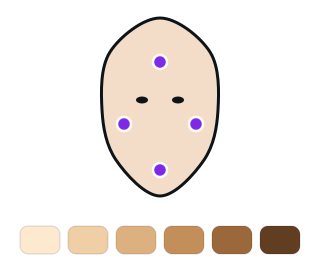
How the foundation shade finder works
Shades are compared with the CIEDE2000 color difference formula, which tracks how people perceive color.
- 1
Upload a selfie
Use natural daylight and a bare or lightly made-up face, looking straight at the camera.
- 2
Skin is sampled
The finder averages skin color from your forehead, both cheeks and chin, avoiding eyes, brows and lips.
- 3
Get matched shades
See your skin tone, undertone and the closest shades across 35 foundations from five brands.
Skin tone finder: six tone groups
The skin tone finder sorts your selfie into one of six groups, from fair to deep. Labels differ by brand, so use them as a starting point.
Fair
The lightest group. Often labeled porcelain, ivory or the lowest shade numbers.
Light
Light skin with visible warmth or pink. Common labels include light, nude and beige.
Light medium
Between light and medium, often where sand, natural and buff shades sit.
Medium
The middle of most ranges, with golden, olive or neutral hints.
Tan
Deeper golden or caramel skin; check both warm and neutral options.
Deep
Rich, deep skin where red, neutral and golden undertones vary widely.
What shade foundation am I?
Your shade is depth plus undertone. Depth gets you close; undertone is what makes a shade disappear on skin.
Warm
Golden, yellow or peachy hints. Veins look greenish and gold jewelry tends to flatter. Look for W or golden shades.
Cool
Pink, red or bluish hints. Veins look blue or purple and silver tends to flatter. Look for C or pink shades.
Neutral
A balance of warm and cool. Both gold and silver work, and N shades usually match best.
Olive
A subtle green-gray cast over warm or neutral skin. Often misread as neutral; try olive or neutral-warm shades.
How to test your match in store
- Swatch your top two shades side by side along the jawline, not the hand.
- Check the stripes in daylight by a window, not under store lights.
- Wait ten minutes — many formulas oxidize and turn slightly darker.
- The right shade blends into your neck without a visible line.
- Between two shades? Pick the lighter one and warm it with bronzer.
- Skin often darkens in summer, so re-check your match each season.
Foundation shade finder methods compared
Brand finders, quizzes and selfie tools all try to answer "what shade am I?" in different ways.
| Method | How it works | Strength | Weakness |
|---|---|---|---|
| Selfie shade finder (this page) | Reads depth and undertone from your skin in a photo, then suggests shades across brands. | Works for every brand at once; photo stays on your device. | Room lighting and white balance shift the reading. |
| Brand quiz | You answer questions about your skin, veins and how you tan. | No photo needed. | Self-reported answers are often wrong, especially undertone. |
| Shade-to-shade matcher | You enter a shade you already wear and get its match in another brand. | Very reliable if your current shade is right. | Useless if you don't have a match yet. |
| In-store color match | A consultant or a device swatches on your skin. | Real product on real skin. | Store lighting is rarely daylight; you may feel pushed to buy. |
The most reliable path: use a selfie finder to narrow the range, then swatch two or three shades along your jaw in daylight.
How to read foundation shade names
Most brands encode depth and undertone in the shade name. Once you can read it, a foundation shade finder result transfers between brands.
Number = depth
Most ranges number from lightest to deepest, such as 110 to 590 or 1 to 10. The scale differs by brand, so compare positions in the range, not raw numbers.
Letters = undertone
W or Y usually means warm or yellow, C or P cool or pink, N neutral, and some brands add O for olive or R for red.
Words = description
Names like "Warm Honey" or "Cool Ivory" put the undertone first. "Golden", "beige" and "sand" usually lean warm; "porcelain" and "rose" lean cool.
How to test the shades your foundation shade finder suggests
- Swatch three stripes on your jawline, not your hand or wrist.
- Choose one shade at the suggested depth and one either side of it.
- Let them dry for ten minutes; many foundations oxidize and darken slightly.
- Check them in daylight by a window, then in your phone's camera.
- The right shade disappears into both your face and your neck.
- If your face is redder or darker than your neck, match to your neck and color-correct the face.
- Re-check your shade when seasons change; you may need two.
- Mix two shades for an in-between match rather than settling.
Foundation looks wrong? Common fixes
Looks orange
Too warm or too dark. Go one step lighter or one step more neutral. Also check whether the formula oxidizes.
Looks grey or ashy
Too light or too cool, a common problem on deep skin. Move to a deeper or warmer shade with more red or gold.
Looks pink
Too cool for a warm or olive undertone. Try a neutral or golden shade at the same depth.
Face and neck don't match
Match the neck and blend down; use bronzer rather than a deeper foundation to warm the face.
Looks fine indoors, wrong outside
Indoor bulbs are warm and hide mismatches. Always do the final check in daylight.
Olive skin, nothing matches
Olive undertones have green in them and are under-served. Look for O or neutral-golden shades, and mix in a drop of a green-based primer if needed.
Beyond shade: choosing a foundation formula
Once your foundation shade finder has narrowed the depth and undertone, the formula decides how the shade looks on your skin. Dewy formulas look a little lighter and brighter; matte formulas can look slightly deeper because they reflect less light.
Coverage matters too. Sheer formulas let your own skin show through and are forgiving if the match is slightly off. Full coverage formulas need an exact match, because they replace your skin tone rather than evening it.
Your undertone result is also useful well beyond foundation. It guides concealer, blush, lipstick and even the hair and clothing colors that suit you best.
Skin tone analyzerBlush shade finderHair colors for your undertone
Foundation shade finder scenarios
"I'm between two shades"
Buy both and mix them: more of the lighter one in winter, more of the deeper one in summer. Many people find this the most exact match.
"I have redness"
Redness can make a selfie read cooler than your true undertone. Choose a neutral or slightly warm shade and use a green-tinted primer under it.
"My skin is tanned right now"
Your depth will shift as the tan fades, but your undertone won't. Re-run the finder at the end of summer and keep the same undertone family.
Double-checking your undertone before you buy
Undertone is where most foundation mismatches come from. Before you order, check the result two ways: run the foundation shade finder in daylight, then hold a white sheet of paper next to your bare face in the same light. If the skin looks golden next to the white, you are warm; if it looks pink or rosy, you are cool; if it's hard to tell, you are probably neutral.
If you still get conflicting answers, try a neutral shade first. Neutral foundations are the most forgiving, and you can warm them up with bronzer or cool them down with a pink-toned blush.
Find your foundation shade based on another brand
If one foundation already matches you, use it to find your shade elsewhere.
- Note your current shade's name, number and undertone letter.
- Find where it sits in that brand's range: light, light-medium, medium and so on.
- In the new brand, go to the same position in the range with the same undertone.
- Check the new brand's swatches on someone with a similar skin tone.
- Order the nearest two shades and test them on your jawline in daylight.
- Not sure your current shade is right? Start with the shade finder instead.
Foundation shade finder FAQ
Curious about your features too? Try the free face shape detector.
What shade foundation am I?
Your shade is your skin depth plus your undertone. The finder measures both from your forehead, cheeks and chin, then lists the closest of 35 shades. Swatch the top two on your jawline in daylight before you buy.
Can I use it as a skin tone finder only?
Yes. Every result shows your skin tone group, from fair to deep, and your undertone — warm, cool, neutral or olive — above the shade matches, so it works as a free skin tone finder even if you don't wear foundation.
Is it free to use?
Yes, completely free. No sign-up, no paywalls and no usage limits. The analysis runs entirely in your browser.
Does my photo get uploaded to a server?
No. Face detection uses Google's MediaPipe model in your browser and your photo never leaves your device.
How accurate is the shade match?
Colors are compared in the CIELAB color space using the CIEDE2000 difference formula. Lighting and camera white balance shift results, so natural daylight works best — always swatch the closest two shades on your jaw before buying.
Which brands are included?
Fenty Beauty, MAC, NARS, Estée Lauder and Maybelline — 35 shades in total.
What kind of photo works best?
Face a window in daylight, remove heavy makeup and glasses, and avoid filters or beauty modes that smooth or tint the skin.
How do I know my foundation shade without going to a store?
Use a selfie shade finder in daylight to get your depth and undertone, then order samples or the two nearest shades and test them on your jawline.
Should foundation match my face or my neck?
Usually the neck, or a shade in between, so there is no visible line at the jaw. Warm up the face with bronzer if needed.
Why does my foundation get darker during the day?
Some formulas oxidize when they react with skin oils and air. If yours does, choose half a shade lighter or try a different formula.
What does N, W and C mean in foundation shades?
Usually neutral, warm and cool undertone. Some brands use Y for yellow, P for pink, R for red and O for olive.
How do I match foundation online?
Find your depth and undertone with a shade finder, compare the suggested shade's position in each brand's range, and order the nearest two to test.
What foundation shade am I if I'm pale?
Look at the lightest few shades in a range and choose by undertone: pink or porcelain for cool, ivory or golden for warm, and beige or neutral if you're unsure.
Can a selfie really match my foundation?
A daylight selfie gets your depth and undertone close enough to narrow a range to two or three shades. Test those on your jawline to confirm.
Why does every brand say I'm a different shade?
Brands number and name shades differently, and formulas oxidize differently. Compare your shade's position in each range rather than its number.
Can I find my foundation shade with a photo online for free?
Yes. Upload a daylight selfie to the foundation shade finder. It reads your depth and undertone in your browser and suggests shades to try.
More from StyleMirror
Match your makeup, then try a new hair color
Preview copper, blonde or brunette shades on your own photo with the AI hairstyle changer.
Try a hair color