Short cuts · short length
Buzz cut: pick the guard number first
A buzz cut is a single clipper length over the whole head, usually between a number 1 and a number 4. It takes no styling, costs almost nothing to maintain, and is the most honest cut there is: it shows your head shape, your hairline and your scalp exactly as they are. The guard number is the only real decision.
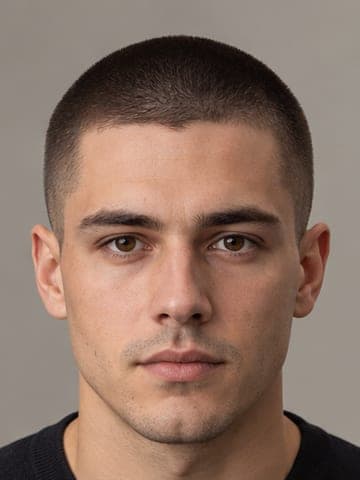
What a buzz cut actually is
Guard numbers are eighths of an inch. A number 1 leaves about 3mm, a 2 about 6mm, a 3 about 10mm and a 4 about 13mm. The jump from a 2 to a 3 is the one most people notice: below a 3, scalp shows through on most hair types; at a 3 and above, the hair reads as a solid colour.
A true buzz cut uses one guard everywhere. Many barbers will instead taper the sides a guard shorter than the top, which is technically a different cut and looks less severe — worth deciding before you sit down, because it changes the whole character.
It is the only cut on this site with no styling step at all. There is nothing to part, lift or place, which is both the appeal and the risk: whatever the shape of your skull and hairline, the buzz cut will show it.
How it differs from the cuts people confuse it with
| Crew cut | A crew cut leaves enough length on top to comb forward and tapers the sides shorter. A buzz cut is one length with nothing to style. |
|---|---|
| Classic fade | A fade changes length gradually down the sides. A buzz cut has no gradient at all. |
| Textured crop | A crop keeps several centimetres on top for texture and a fringe. The buzz cut removes that option entirely. |
Who it suits
Because nothing frames the face, the jaw and the skull do all the work. Oval and square faces carry it most easily: a defined jaw gives the head a clear outline at the bottom, which balances the uniform shape above it. A strong brow or cheekbone helps for the same reason.
Hair texture barely matters, which makes this unusual. Coily, curly and straight hair all buzz to the same uniform result at a 1 or 2, and texture only starts to show again at a 4 and above, where curl pattern lifts the hair unevenly.
What matters far more is hair density and hairline. Thinning at the crown is less visible at a 1 or 2 than at any longer length, because the contrast between hair and scalp drops. This is why a buzz cut is often the recommended move at a stage where comb-overs stop working.
When not to pick it
- You have scars, moles or an uneven skull shape you would rather not show. Nothing covers them at this length.
- You are uncertain. Hair grows about a centimetre a month, so reversing it means two to three months before you have options again.
- You burn easily and spend time outdoors. A buzzed scalp needs sunscreen or a hat from day one.
- You want the cut to do something for your face shape. A buzz cut is neutral by design — it reveals, it does not shape.
What to say in the chair
Naming the landmark and the length is what makes the request land.
- Lead with the guard number: "a number 2 all over" is the complete instruction for a true buzz cut.
- Say explicitly whether you want it uniform: "same guard on the sides and top, no taper", or "a 2 on top and a 1 on the sides".
- Say what to do at the neckline: "square off the back" or "follow my natural hairline". A squared neckline looks sharper for a week and then grows out awkwardly; natural grows out invisibly.
- Ask them not to line up the front hairline with a razor if your hairline is receding. A hard line-up looks crisp for days and pushes the hairline back a little each time it is redone.
- If it is your first, start one guard longer than you think. Going from a 3 to a 2 takes thirty seconds at the end of the appointment.
Terms worth knowing
- Guard number
- The clipper attachment, in eighths of an inch. 1 is about 3mm, 4 about 13mm. The single most important word to get right.
- Line-up (edge-up)
- Squaring the front hairline with a razor. Sharp, but worth skipping if your hairline is receding.
- Natural neckline
- Following the hair's own growth at the nape rather than cutting a straight line. Grows out far more cleanly.
- Taper
- Dropping a guard or two at the sides. Softer than a true buzz, and a common default unless you say otherwise.
Upkeep
| Styling time | 0 minutes |
|---|---|
| Back to the salon | 2–4 weeks |
| Effort | 1/5 · Wash and go |
| What you need | Clippers with guards, if cutting at home · Sunscreen or a hat for the scalp · A light moisturiser for the scalp in winter |
There is no daily routine. That is the entire proposition, and it is why people who travel or train often end up here.
The maintenance is frequent but trivial. At a number 2, growth is noticeable in about three weeks, and the cut is simple enough that most people buy clippers and do it themselves after the first professional one. A set of clippers pays for itself in roughly two visits.
The scalp needs attention the hair used to provide. Sunscreen in summer is not optional at a 1 or 2, and a light moisturiser helps in cold weather when the scalp dries out.
Ways it gets cut
The same name covers several shapes. These are the ones worth naming at the salon.
Induction cut
A zero or a one all over, no guard variation. The shortest version there is, closest to bare skin, and the one that shows scalp, scars and head shape most plainly. Grows noticeably within ten days.
Tapered buzz
A three or four on top with the sides dropped a guard or two and blended at the neckline. Softer than a true buzz, more flattering on a round face, and the version most barbers default to unless told otherwise.
Buzz with a fade
A short uniform top over faded sides that run down to skin. Keeps the no-styling benefit but adds a visible gradient, at the cost of needing a barber every two to three weeks rather than clippers at home.
What it costs
Cheaper than any other cut at the barber, and close to free after that: a set of clippers costs about the same as two appointments and lasts years. This is the only cut here where the honest long-term figure is the price of the clippers plus occasional blade oil.
Colours that suit it
How we build these previews
So you know what you are comparing.
We built all 65 cuts in this library — 40on the women's reference model and 25on the men's — from 2 base photographs, one per model, rather than collecting 65 unrelated pictures. Every preview is an edit of that single base photo, so the face, skin texture, pose, clothing, background and lighting are identical across the whole library. The only variable is the hair.
Our method is deliberately constrained: the edit instruction forbids smoothing skin, slimming the face or changing the eyes, because a flattered “after” would make the comparison worthless. That is why the buzz cut above can be read against any other cut here — same person, same light. The before-and-after pairs come from one photograph for the same reason, and when you upload your own picture we use that same pipeline, not a different one.
For the fit advice we measure the same way our face shape detector does: 478 facial landmarksread in your browser with Google's MediaPipe Face Landmarker, then compared against 7 reference shapes on fixed ratios — a length-to-width ratio of 1.6 or more reads as oblong, under 1.3 reads round or square, and a jaw at 92% of cheekbone width or wider reads as square. Nothing is uploaded for that step; it runs on your device.
What this cannot tell you:how your own hair will behave once it is cut. Density, growth pattern, cowlicks and the stylist's hand all change the result, and no preview predicts them. Plenty of faces also sit within a percentage point or two of those thresholds, so a small change in head angle can move the reading — treat the fit advice as a shortlist, not a verdict, then take the shortlist to a salon.
Updated November 2026. We revise a cut's page when the advice or the renders change, not on a schedule.
Buzz cut questions
What guard number should I ask for?
A 2 (about 6mm) is the most common starting point. Below a 3 the scalp shows through on most hair types; at a 3 or 4 the hair reads as solid colour.
Does a buzz cut hide a receding hairline?
It does not hide it, but it stops drawing attention to it. Shortening everything reduces the contrast between where hair is and where it is not, which usually reads better than a comb-over.
How often do I need to cut it?
Every two to four weeks at a number 2. Most people buy clippers and do it themselves after the first professional cut.
Will a buzz cut suit a round face?
It is the hardest case, because nothing adds vertical line or frames the jaw. A slightly longer guard on top than the sides helps a little, though at that point it is closer to a crew cut.
Does hair grow back thicker after a buzz cut?
No. Cutting hair does not change the follicle. Regrowth feels coarser because you are feeling blunt-cut ends rather than tapered ones.
How long does it take to grow out?
About a centimetre a month, so two to three months before you have styling options again and roughly six before it reads as a short cut rather than a grown-out buzz.
Should I get a line-up with a buzz cut?
Only if your hairline is stable. A razored line-up looks sharp for a few days but pushes the hairline back slightly each time it is redone.
Do I need sunscreen on my scalp?
Yes, at a 1 or 2. The scalp has had no sun exposure and burns quickly.
Can I see what a buzz cut looks like on me first?
Yes, and for this cut it is worth it. Upload a front-facing photo to the hairstyle changer and pick the buzz cut; only the hair changes, so you see your own head shape.
Can I cut a buzz cut myself?
Yes, and most people end up doing so. A uniform guard all over is the one haircut that needs no technique; the only awkward part is the back of the neck, which is easier with a second mirror or a helper.
What is the difference between a buzz cut and a crew cut?
A buzz cut is one guard everywhere with nothing to style. A crew cut leaves enough on top to comb forward and tapers the sides shorter, so it has a front and a back.
Related cuts
See the buzz cut on your own face
Upload one front-facing photo. Your face stays yours — only the hair changes.
Try it free