Short cuts · short length
Textured crop: short on the sides, messy on top
A textured crop keeps three to five centimetres on top, cut with heavy texture and worn forward into a short fringe, over faded or tapered sides. It is the default modern short men's cut because it needs barely any styling, suits most hair types, and the fringe gives it a front edge that a crew cut does not have.
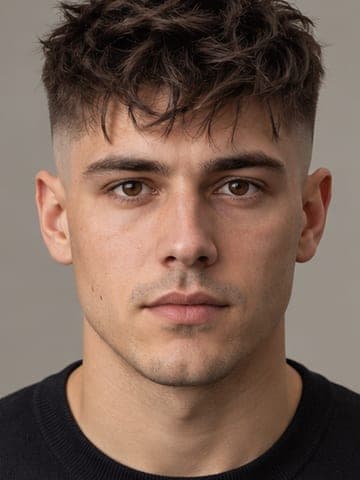
What a textured crop actually is
Two elements define it: a forward-worn top with the weight broken up, and a fringe with a visible front line. The top is usually point-cut or scissor-chopped so the ends separate into pieces rather than sitting flat, and the fringe is cut blunt enough to read as a deliberate edge across the forehead.
The sides are where most of the variation lives. A skin fade takes them to nothing at the bottom and gives maximum contrast; a taper keeps a few millimetres and looks more conservative. The height at which the fade starts — low, mid or high — changes the cut more than the length on top does.
It is more forgiving than it looks. Because the top is meant to be messy, growing a week past due is barely visible, and a bad night's sleep is indistinguishable from the intended finish.
How it differs from the cuts people confuse it with
| French crop | A French crop has a shorter, blunter fringe cut in a straight line. The textured crop's fringe is broken up and sits less severely. |
|---|---|
| Crew cut | A crew cut is tapered shorter at the front and combed, with no fringe. The crop pushes everything forward. |
| Messy fringe | A messy fringe keeps more length at the front and often longer sides. The crop keeps the whole shape close and controlled. |
Who it suits
The fringe is the reason this cut travels so well across face shapes. Bringing hair forward onto the forehead shortens the visible face, which is exactly what a long or oblong face benefits from. On a square face the broken texture softens the top while the faded sides keep the jaw as the widest point.
It handles thick and coarse hair better than most short cuts, because the texturising is doing the job that bulk would otherwise create. Curly and coily hair works too, in a version where the curl provides the texture and the fringe is shaped rather than cut blunt.
The one group it serves less well is men with a very high or receding hairline — not because the cut looks bad, but because the blunt fringe draws a line across the forehead and invites a comparison with where the hairline sits. A softer, less blunt front edge solves most of this.
When not to pick it
- Your hairline is receding at the temples. The blunt fringe creates a straight line that makes the recession read more clearly; ask for a broken fringe instead.
- You want a cut you can part and comb. The crop is worn forward and does not hold a side part.
- Your hair is very fine and sparse on top. There is not enough bulk for the texturising to create separation, so the top can look flat.
- You dislike visiting a barber. A skin fade is visibly grown out at three weeks; a taper buys you a little more time.
What to say in the chair
Naming the landmark and the length is what makes the request land.
- Start with the name and a photo, then be specific about three things: length on top, fade height, and fringe.
- Length on top: "about four centimetres on top" or "leave enough to push forward".
- Fade height: "low fade" starts just above the ear, "mid fade" at the temple, "high fade" near the corner of the head. This decides how severe the cut looks.
- Fringe: "a blunt fringe sitting just above the eyebrow" or, if your hairline is receding, "a broken fringe, not a straight line".
- Ask for the top to be texturised with scissors rather than thinning shears — point-cut, so the ends separate without the top becoming see-through.
Terms worth knowing
- Skin fade
- The sides taken down to bare skin at the bottom. Maximum contrast and the shortest maintenance window.
- Fade height
- Where the shortest point starts: low (above the ear), mid (temple), high (corner of the head). This changes the cut's character most.
- Point cutting
- Cutting into the ends at an angle with scissors so they separate. What creates the texture, as opposed to thinning the whole section.
- Broken fringe
- A front edge cut unevenly rather than straight across. The fix if a blunt line would underline a receding hairline.
Upkeep
| Styling time | 2–3 minutes |
|---|---|
| Back to the salon | 3–5 weeks |
| Effort | 2/5 · Low effort |
| What you need | A matte clay or paste · A hairdryer, optional, for pushing the fringe forward |
Styling is a small amount of matte clay rubbed between the palms and pushed forward through dry hair. There is no brushing and no part to maintain, which is why this cut has become the default: it survives a hurried morning without looking unplanned.
The maintenance interval is set by the sides, not the top. A skin fade loses its definition within three weeks because the shortest section grows into the next; a taper stretches to five or six. If you want longer between visits, ask for a taper rather than a skin fade and accept slightly less contrast.
Ways it gets cut
The same name covers several shapes. These are the ones worth naming at the salon.
Low-fade crop
The fade starts just above the ear, so most of the side length stays. The most conservative version, it passes in any workplace and buys an extra week or two between appointments because there is less contrast to lose.
High-fade crop
The fade starts near the corner of the head, leaving a narrow band of length on top. Much sharper, much more visible, and the shortest maintenance window of the three — about three weeks before the gradient fills in.
Curly crop
The top left at four or five centimetres of natural curl over faded sides, shaped rather than point-cut. The curl supplies the texture, so there is no need for the heavy scissor work a straight-haired crop relies on.
Crop with a broken fringe
The front edge cut unevenly instead of straight across. This is the version to ask for if your hairline is receding, because there is no hard horizontal line inviting a comparison with where the hair starts.
What it costs
A fade is more work than a clipper cut, so it costs more per visit, and the visit frequency is high. Three to five weeks means ten to fifteen appointments a year. Choosing a taper over a skin fade is the single biggest saving available, and it costs you very little in how the cut looks.
Colours that suit it
Dark brown
Enough depth for the faded sides to show a clear gradient, which is where the cut's shape actually reads.
Jet black
The strongest contrast between the faded sides and the textured top, so the silhouette is legible from a distance.
Light brown
Lighter ends on top catch the light and make the point-cut separation visible, which dark shades can hide.
How we build these previews
So you know what you are comparing.
We built all 65 cuts in this library — 40on the women's reference model and 25on the men's — from 2 base photographs, one per model, rather than collecting 65 unrelated pictures. Every preview is an edit of that single base photo, so the face, skin texture, pose, clothing, background and lighting are identical across the whole library. The only variable is the hair.
Our method is deliberately constrained: the edit instruction forbids smoothing skin, slimming the face or changing the eyes, because a flattered “after” would make the comparison worthless. That is why the textured crop above can be read against any other cut here — same person, same light. The before-and-after pairs come from one photograph for the same reason, and when you upload your own picture we use that same pipeline, not a different one.
For the fit advice we measure the same way our face shape detector does: 478 facial landmarksread in your browser with Google's MediaPipe Face Landmarker, then compared against 7 reference shapes on fixed ratios — a length-to-width ratio of 1.6 or more reads as oblong, under 1.3 reads round or square, and a jaw at 92% of cheekbone width or wider reads as square. Nothing is uploaded for that step; it runs on your device.
What this cannot tell you:how your own hair will behave once it is cut. Density, growth pattern, cowlicks and the stylist's hand all change the result, and no preview predicts them. Plenty of faces also sit within a percentage point or two of those thresholds, so a small change in head angle can move the reading — treat the fit advice as a shortlist, not a verdict, then take the shortlist to a salon.
Updated November 2026. We revise a cut's page when the advice or the renders change, not on a schedule.
Textured crop questions
How long should the top be for a textured crop?
Three to five centimetres. Shorter than three and there is not enough to push forward; longer than five and it starts behaving like a fringe cut instead.
What fade height should I ask for?
Low starts just above the ear and is the most conservative; mid sits at the temple; high near the corner of the head and is the most severe. Mid is the usual default.
Is a textured crop good for a receding hairline?
The cut is fine but the blunt fringe is not. Ask for a broken fringe rather than a straight line, so there is no hard edge inviting comparison with the hairline.
What is the difference between a textured crop and a French crop?
The fringe. A French crop's fringe is cut blunt and straight; the textured crop's is broken up and sits less severely.
How often does it need cutting?
Three to five weeks, set by the sides. A skin fade grows out visibly at three; a taper stretches to five or six.
Does a textured crop work on curly hair?
Yes. The curl supplies the texture, so the top is shaped rather than heavily point-cut, and the fringe is left to fall in its own pattern.
Can I part a textured crop?
No. It is worn forward by design and will not hold a side part without daily heat and product.
What product should I use?
A matte clay or paste. Anything with shine fights the messy finish the cut is built around.
How do I know if it suits my face?
Upload a front-facing photo to the hairstyle changer and pick the textured crop. The fringe is the part to judge, because it changes how long your face reads.
Can I get a textured crop if my hair is thinning on top?
Up to a point. The forward direction and the texture both help disguise lower density, which is why barbers often suggest it. Once the scalp shows through the top section in normal light, a shorter uniform cut reads better than a crop.
How do I stop a textured crop looking flat?
Dry it forward from the roots for thirty seconds before applying product. Clay worked into flat, fully dry hair sticks the top down; the same clay on hair that has been dried forward holds the separation the cut was built for.
Related cuts
See the textured crop on your own face
Upload one front-facing photo. Your face stays yours — only the hair changes.
Try it free