Bangs & fringe · medium length
Curtain bangs: try them before you cut
Curtain bangs are a long fringe parted down the middle that sweeps outwards on both sides, shortest at the cheekbone and blending into the length by the jaw. They cover the forehead without the commitment of a blunt fringe, grow out without an awkward stage, and suit almost every face shape because the length is adjustable.
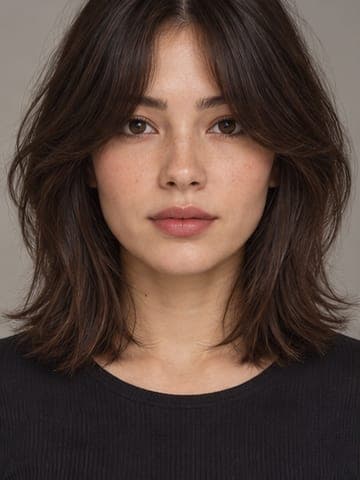
What a curtain bangs actually is
The shape is defined by two things: a centre split, and a soft diagonal line on each side. The shortest point sits somewhere between the outer eyebrow and the cheekbone, and from there the fringe lengthens outward until it merges with the hair around the jaw. Because the line is diagonal rather than horizontal, there is no hard edge anywhere, which is what makes them forgiving.
They are cut into existing length rather than being a haircut in their own right. That means you can add them to a bob, long layers or a wolf cut, and the same request will look different depending on what the rest of the hair is doing. It also means they are one of the few changes that is genuinely low-risk: the shortest piece is still long enough to tuck behind an ear.
The grow-out is the practical argument for them. A blunt fringe passes through a stage where it sits in your eyes and can only be pinned. Curtain bangs just become longer face-framing layers, which is a shape people pay for on purpose.
How it differs from the cuts people confuse it with
| Side-swept bangs | Side-swept bangs part off-centre and fall across the forehead in one direction. Curtain bangs split in the middle and move away from the face on both sides. |
|---|---|
| Blunt bangs | Blunt bangs are cut straight across at eyebrow level with a hard line. Curtain bangs have no horizontal line at all and start much longer. |
| Wispy bangs | Wispy bangs are thinned so the forehead shows through. Curtain bangs keep their density and get their softness from length and direction instead. |
Who it suits
They work across more face shapes than almost any other fringe, because you choose where the shortest point lands. On a round or square face, starting the short point at the cheekbone and sweeping it outward creates a vertical line down each side of the face, which narrows the widest part. On a long or oblong face, starting lower — nearer the jaw — shortens the visible forehead and breaks up the length.
On a heart-shaped face they balance a wider forehead by covering part of it while keeping volume away from the temples. On a diamond face the outward sweep adds width exactly where the face is narrowest, at the cheekbone and temple.
Hair texture changes the technique, not the suitability. Straight hair gets the cleanest version and needs the least styling. Wavy hair needs the shortest point cut slightly longer, because waves spring up once dry. Very curly hair can carry curtain bangs, but they have to be cut dry and curl-by-curl, and the result reads as a soft curly fringe rather than a clean centre split.
When not to pick it
- You have a strong cowlick at the front hairline. It will push one side of the curtain the wrong way, and the only fix is daily heat styling.
- You never use a hairdryer. Curtain bangs are the one part of the cut that genuinely needs a minute of directed air to sit right; air-dried, they tend to fall straight down the middle.
- Your hairline is receding at the temples. The outward sweep draws the eye exactly there.
- You want to look noticeably different. This is a subtle change — if you want a visible transformation, a blunt fringe or a shorter cut will do more.
What to say in the chair
Naming the landmark and the length is what makes the request land.
- Name the landmark for the shortest point: "shortest at the cheekbone" or, for a longer version, "shortest at the corner of the mouth".
- Say where the ends should blend: "blend into the length by the jaw" keeps the curtain connected to the rest.
- Ask for them to be cut dry if your hair is wavy or curly, so the spring-up is accounted for before the scissors commit.
- Say whether you want them dense or soft: "keep them solid" reads stronger; "take a little weight out of the inside edge" reads softer without becoming wispy.
- Ask to start long. Request the cheekbone length on the first visit even if you want them shorter; they can come up a centimetre at the next trim.
Terms worth knowing
- Triangle section
- The wedge of hair at the front the stylist isolates to cut the fringe. A wider triangle gives a heavier curtain, a narrower one a lighter one.
- Soft blend
- Connecting the fringe to the surrounding length so there is no step. Ask for this if you do not want a separate-looking fringe.
- Dusting
- Trimming a few millimetres off the ends only. This is all curtain bangs need between full cuts.
Upkeep
| Styling time | 2–4 minutes |
|---|---|
| Back to the salon | 6–10 weeks for a dusting |
| Effort | 2/5 · Low effort |
| What you need | A round brush, or just a hairdryer nozzle · A dry shampoo or light powder for the roots |
The daily routine is short but not optional. Dry the fringe first, while the rest is still damp, directing the air from the roots outwards and away from the centre — this sets the split and the outward sweep in under two minutes. Leaving them to air-dry usually produces a flat centre part that falls into the eyes.
They are the fastest-growing visible part of any cut, so the maintenance interval is shorter than the haircut's. A dusting every six to ten weeks keeps the shortest point where you want it; many salons do this between appointments at low or no cost, which is worth asking about when you book the original cut.
Ways it gets cut
The same name covers several shapes. These are the ones worth naming at the salon.
Short curtain
Shortest point at the outer eyebrow. The most visible version, closest to a 1970s fringe, and the one that changes your face the most. It also needs the most frequent dusting because the short point moves fastest.
Long curtain
Shortest point level with the corner of the mouth. Barely reads as a fringe at all and blends straight into face-framing layers, which makes it the safest first attempt and the easiest to abandon.
Bottleneck bangs
A narrower version that stays close together at the shortest point and flares out sharply towards the cheekbone, so the silhouette resembles the neck of a bottle. It covers more of the forehead than a standard curtain while still parting in the middle, which suits a wider forehead or a higher hairline.
Curly curtain
Cut dry and left considerably longer to allow for spring-up. The centre split is softer because curls do not fall in a straight diagonal, so the result frames the face rather than drawing two clean lines.
What it costs
Adding them to an existing cut is usually a small charge on top of a trim, and many salons will dust them between appointments at low or no cost. Ask about that when you book the original cut, because it changes the real yearly cost more than the cut price does.
Colours that suit it
Honey blonde
Lighter pieces at the inner edge of the curtain catch the light and make the outward sweep obvious even when the hair is flat.
Dark brown
Keeping depth at the front edge makes a dense curtain read as deliberate rather than as hair falling forward.
Balayage
Because the fringe blends into the length, painted colour that follows the same diagonal line reinforces the shape.
How we build these previews
So you know what you are comparing.
We built all 65 cuts in this library — 40on the women's reference model and 25on the men's — from 2 base photographs, one per model, rather than collecting 65 unrelated pictures. Every preview is an edit of that single base photo, so the face, skin texture, pose, clothing, background and lighting are identical across the whole library. The only variable is the hair.
Our method is deliberately constrained: the edit instruction forbids smoothing skin, slimming the face or changing the eyes, because a flattered “after” would make the comparison worthless. That is why the curtain bangs above can be read against any other cut here — same person, same light. The before-and-after pairs come from one photograph for the same reason, and when you upload your own picture we use that same pipeline, not a different one.
For the fit advice we measure the same way our face shape detector does: 478 facial landmarksread in your browser with Google's MediaPipe Face Landmarker, then compared against 7 reference shapes on fixed ratios — a length-to-width ratio of 1.6 or more reads as oblong, under 1.3 reads round or square, and a jaw at 92% of cheekbone width or wider reads as square. Nothing is uploaded for that step; it runs on your device.
What this cannot tell you:how your own hair will behave once it is cut. Density, growth pattern, cowlicks and the stylist's hand all change the result, and no preview predicts them. Plenty of faces also sit within a percentage point or two of those thresholds, so a small change in head angle can move the reading — treat the fit advice as a shortlist, not a verdict, then take the shortlist to a salon.
Updated November 2026. We revise a cut's page when the advice or the renders change, not on a schedule.
Curtain bangs questions
Do curtain bangs suit a round face?
Yes, and they are one of the better choices for one. Starting the shortest point at the cheekbone and sweeping outward creates a vertical line on each side of the face, which narrows the widest part.
How short should curtain bangs be?
The shortest point usually sits between the outer eyebrow and the cheekbone. On a longer face, dropping it closer to the mouth shortens the forehead more.
Are curtain bangs high maintenance?
Low effort but daily. Two minutes of directed drying sets them; skipping it leaves them falling flat down the middle.
How long do curtain bangs take to grow out?
There is no awkward stage. Within two to three months they read as long face-framing layers, so you can simply stop trimming them.
Can I get curtain bangs with curly hair?
Yes, but they must be cut dry, curl by curl. The result is a soft curly fringe rather than a crisp centre split, and the shortest piece needs to be left longer to allow for spring-up.
Will they work if I have a cowlick?
A front cowlick will push one side the wrong way, and daily heat is the only reliable fix. Show your stylist the cowlick before they section the fringe.
What is the difference between curtain bangs and a middle part?
A middle part is where you split the whole head of hair. Curtain bangs are a shorter front section cut specifically to fall away from the face on each side.
Do curtain bangs work on thin hair?
Yes. Because they rely on length and direction rather than density, they do not need thick hair. Keep the triangle section narrow so you are not taking too much from the top.
Can I preview curtain bangs on my own photo?
Yes. Upload a front-facing selfie to the hairstyle changer, pick curtain bangs, and it changes only the hair.
Related cuts
See the curtain bangs on your own face
Upload one front-facing photo. Your face stays yours — only the hair changes.
Try it free