Bobs · short length
French bob: the shortest bob worth trying
A French bob is a short blunt bob that ends between the cheekbone and the jaw, normally with a light fringe and a visible, unlayered hemline. It is shorter than a classic bob and deliberately slightly undone, so it keeps weight at the ends rather than being texturised away.
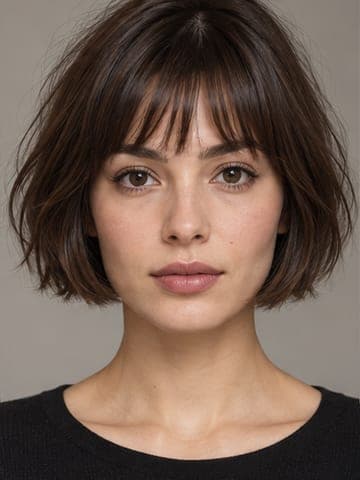
What a french bob actually is
Two things separate it from other bobs: the length and the weight. The hemline sits high — often level with the mouth, sometimes at the cheekbone — and that line is kept blunt, so the ends stay dense. Most shorter cuts remove weight to stop them looking heavy; a French bob keeps it, which is what gives the shape its clean outline.
The fringe is conventional but not compulsory. When it is there, it is usually light and sits at or just below the eyebrow, often with a slight centre separation rather than a solid block. The combination of a high hemline and a soft fringe is what reads as French rather than simply short.
It is cut to the head shape more than to a measurement, because at this length the way the hair falls around the ear and the nape is visible from every angle. Expect the stylist to spend time on the back; that is where a short blunt bob either works or does not.
How it differs from the cuts people confuse it with
| Classic bob | A classic bob sits at the chin and is often softened at the ends. A French bob is shorter, keeps a harder hemline, and usually has a fringe. |
|---|---|
| Blunt bob | A blunt bob is the same hard-line idea at jaw length and typically without a fringe. The French version is shorter and softer in the front. |
| Long bob | A long bob sits at the collarbone, so it can still be tied back. A French bob cannot, which is the main practical difference. |
Who it suits
The high hemline draws attention to the cheekbone and jaw, so it rewards faces where that line is already a feature — oval, heart and diamond shapes in particular. On a heart-shaped face the width of the hemline at jaw level balances a wider forehead, and the fringe covers part of it.
On a square face it can work very well, but the hemline should land at the jaw rather than above it. Ending the cut exactly level with the widest point of the jaw emphasises the corner; dropping it a centimetre lower softens it.
Fine hair benefits most. A blunt line at a short length makes thin hair look denser than any layered cut can, because all the remaining weight is concentrated in one visible edge. Thick and very curly hair is harder: the same blunt line turns into a triangle as the hair expands outward, and controlling that needs internal weight removal that works against the point of the cut.
When not to pick it
- Your hair is thick and coarse. The blunt hemline will widen into a triangle shape, and thinning it internally undoes the clean line that makes the cut work.
- You tie your hair up for sport or work. At this length nothing reaches a ponytail, and clips are the only option for months.
- You have a strong nape cowlick. At cheekbone length the back of the neck is fully visible and a cowlick there will lift the hemline on one side every day.
- You are not prepared to visit a salon every six to eight weeks. Short blunt shapes lose their outline faster than any other cut.
What to say in the chair
Naming the landmark and the length is what makes the request land.
- Give the hemline a landmark, not a number: "ends level with the corner of my mouth" or "ends at the jaw" is unambiguous.
- Say you want the hemline kept blunt: "keep the ends heavy, no internal thinning".
- Decide about the fringe out loud: "a light fringe just below the eyebrow with a slight centre split", or "no fringe".
- Ask what the back will do. At this length the nape is on show — ask whether your hair will sit flat there or needs to be graduated.
- If you are coming from long hair, ask to stop at the jaw on the first visit. Going to the cheekbone is a second appointment, not a first.
Terms worth knowing
- Blunt hemline
- The ends cut on a single clean line with no tapering. This is the defining feature; say it explicitly.
- Graduation
- Slightly shorter layers underneath that make the hair tuck under rather than flick out. Useful at the nape, unwelcome through the ends.
- Internal thinning
- Removing weight from inside the section so the outside line stays intact. Appropriate for thick hair, but it reduces the density the cut relies on.
Upkeep
| Styling time | 5–8 minutes |
|---|---|
| Back to the salon | 6–8 weeks |
| Effort | 3/5 · Some styling |
| What you need | A flat or paddle brush · A hairdryer with a nozzle · A light smoothing cream for the hemline |
A blunt short bob is only as good as its line, and the line depends on drying. Dry the ends downwards with a nozzle and a flat brush for a few minutes and the hemline stays sharp; let it dry on its own and it will kink outwards at the level of the ear, which is the one angle other people see most.
The salon interval is genuinely short. Two centimetres of growth is invisible on long hair and obvious on a cheekbone-length bob, because it moves the hemline off the facial landmark the cut was built around. Six to eight weeks is realistic; stretching to twelve turns a French bob into an ordinary chin-length bob.
Ways it gets cut
The same name covers several shapes. These are the ones worth naming at the salon.
Fringeless French bob
Same high blunt hemline, no fringe, with the front length left to fall either side of the face. Better if your hairline is uneven or you have a front cowlick, and it grows out into a classic bob without an awkward stage.
Wavy French bob
The same cut air-dried with texture rather than smoothed. The hemline reads softer and the salon interval stretches a little, because a wave disguises two weeks of growth that a smooth line would show.
Cheekbone bob
The shortest version, with the hemline level with the cheekbone and the ears fully exposed. It is close to a long pixie in commitment, and it is a second appointment rather than a first.
What it costs
A precise short blunt cut takes longer in the chair than a long trim, so the sitting costs more. The bigger number is frequency: at six to eight weeks you are paying for roughly seven cuts a year rather than three, which is the part worth working out before committing.
Colours that suit it
Jet black
Maximum contrast between hair and skin makes the blunt hemline read as a graphic line, which is the strongest version of this cut.
Chestnut
A warm mid-brown keeps the line visible while being far more forgiving on regrowth than black.
Platinum
At this length the bleached hair volume is small, so the upkeep is less punishing than on long hair, and the hemline still reads clearly.
Before and after, same photo
Both frames are the same photo and the same lighting; only the hair was changed, through the same pipeline the tool uses on your own upload. The face, skin and clothing are untouched, so the hemline is the only thing you are comparing.
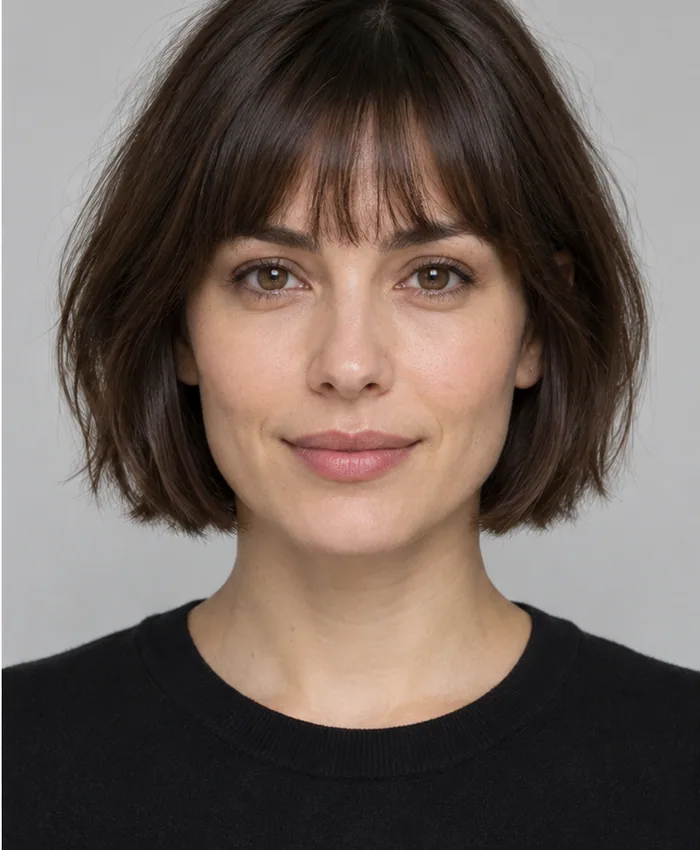
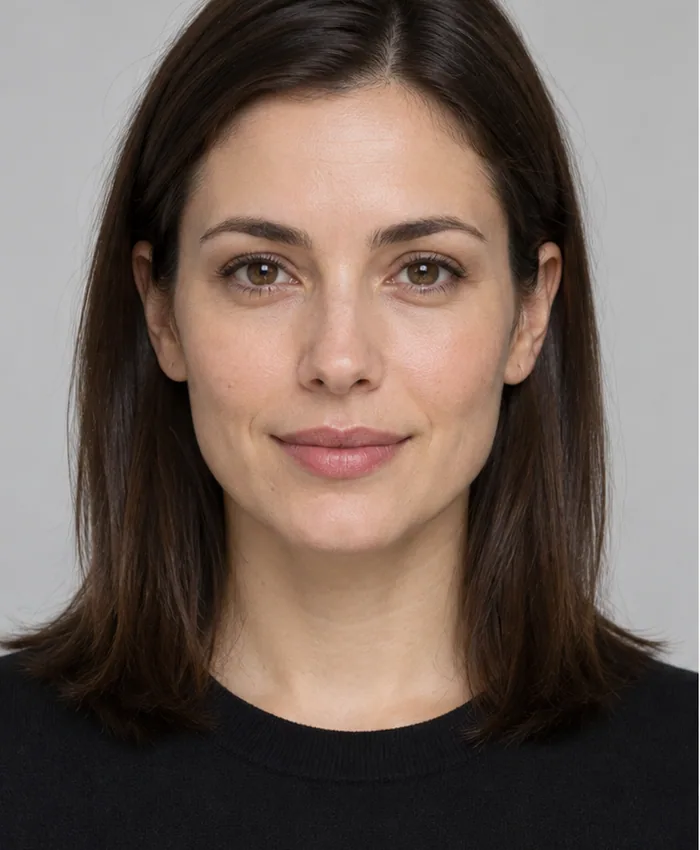 BeforeAfter · French bob
How we build these previews
So you know what you are comparing.
We built all 65 cuts in this library — 40on the women's reference model and 25on the men's — from 2 base photographs, one per model, rather than collecting 65 unrelated pictures. Every preview is an edit of that single base photo, so the face, skin texture, pose, clothing, background and lighting are identical across the whole library. The only variable is the hair.
Our method is deliberately constrained: the edit instruction forbids smoothing skin, slimming the face or changing the eyes, because a flattered “after” would make the comparison worthless. That is why the french bob above can be read against any other cut here — same person, same light. The before-and-after pairs come from one photograph for the same reason, and when you upload your own picture we use that same pipeline, not a different one.
For the fit advice we measure the same way our face shape detector does: 478 facial landmarksread in your browser with Google's MediaPipe Face Landmarker, then compared against 7 reference shapes on fixed ratios — a length-to-width ratio of 1.6 or more reads as oblong, under 1.3 reads round or square, and a jaw at 92% of cheekbone width or wider reads as square. Nothing is uploaded for that step; it runs on your device.
What this cannot tell you:how your own hair will behave once it is cut. Density, growth pattern, cowlicks and the stylist's hand all change the result, and no preview predicts them. Plenty of faces also sit within a percentage point or two of those thresholds, so a small change in head angle can move the reading — treat the fit advice as a shortlist, not a verdict, then take the shortlist to a salon.
Updated November 2026. We revise a cut's page when the advice or the renders change, not on a schedule.
French bob questions
What length is a French bob?
Between the cheekbone and the jaw. Level with the corner of the mouth is the most common version; at the cheekbone it is the shortest form.
Does a French bob need a fringe?
No, but most versions have one. A light fringe just below the eyebrow is what distinguishes it from a plain blunt bob.
Is a French bob good for thin hair?
It is one of the best cuts for it. A blunt line at a short length concentrates all the remaining weight into one visible edge, which looks denser than any layered alternative.
Will a French bob suit a square jaw?
Yes, if the hemline lands at the jaw rather than exactly on its widest point. A centimetre lower softens the corner instead of underlining it.
How often does a French bob need cutting?
Every six to eight weeks. The cut is built around a facial landmark, so even two centimetres of growth changes the shape.
Can I get a French bob with curly hair?
It is difficult. The blunt hemline expands into a triangle as curls spring outward, and the internal weight removal that controls it works against the clean line the cut depends on.
What is the difference between a French bob and a classic bob?
Length and weight. A classic bob sits at the chin with softened ends; a French bob is shorter, keeps a hard hemline, and usually adds a fringe.
Can I tie a French bob back?
No. Nothing reaches a ponytail at this length, and clips are the only option until it grows several centimetres.
How do I know if it will suit me before cutting?
Upload a front-facing photo to the hairstyle changer and pick the French bob. Only the hair changes, so you are judging the hemline against your own jaw and cheekbone.
Will a French bob make my face look rounder?
It can if the hemline stops exactly at the widest point of your cheek, because the horizontal line sits where the face is already widest. Dropping the ends to the jaw, or adding a slight forward angle so the front is a centimetre longer than the back, counteracts it.
Related cuts
See the french bob on your own face
Upload one front-facing photo. Your face stays yours — only the hair changes.
Try it free