Layers & shag · medium length
Wolf cut: see it on your own face first
A wolf cut is a shag–mullet hybrid. The crown and face-framing pieces are cut short and heavily textured, the back and sides stay long and wispy, and the weight sits high on the head instead of at the ends. It reads as deliberately undone, needs no daily heat, and works best on medium to long hair with some natural movement.
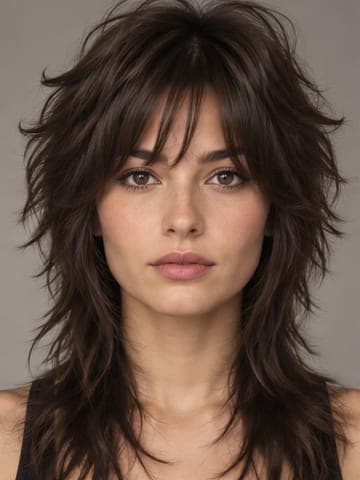
What a wolf cut actually is
The defining feature is where the weight sits. A conventional layered cut keeps most of its bulk near the ends, so the hair hangs down. A wolf cut removes weight from the ends with point-cutting and slide-cutting, then stacks short layers through the crown, so volume collects at the top of the head and the ends taper to a soft, broken line. The shortest layers usually land between the cheekbone and the chin; the longest stay at collarbone length or past it.
It is cut dry more often than wet, because the stylist is shaping how each piece falls rather than measuring a hemline. That is also why two wolf cuts on the same length of hair can look very different: the result depends on how much texture is removed and how high the shortest layer starts, not on a fixed formula.
Expect a visible difference in density between the top and the ends. That contrast is the point. If the cut looks evenly thick from root to tip, the texturising was too conservative and it will read as ordinary long layers.
How it differs from the cuts people confuse it with
| Classic shag | A shag spreads its layers evenly from crown to ends and keeps a fuller perimeter. A wolf cut is more extreme at both ends: shorter on top, wispier at the bottom. |
|---|---|
| Butterfly cut | A butterfly cut keeps the perimeter long and blunt and only adds short face-framing layers, so it looks long when tied back. A wolf cut thins the perimeter too, so the length reads lighter. |
| Modern mullet | A mullet keeps a clear short-front, long-back split. A wolf cut blends the two, so there is no hard line between the sides and the back. |
Who it suits
The short crown layers add height, and height is what lengthens a face visually. That makes the cut a reliable choice on round and square faces, where the width across the cheekbones or jaw is close to the face's length. The wispy face-framing pieces also break up a strong jawline without hiding it.
Texture matters more than face shape here. Natural waves and curls hold the broken, piecey shape with no effort, because the hair already wants to separate into sections. Thick straight hair works too, and often benefits most, since the texturising removes bulk that used to sit as a solid block. Pin-straight fine hair is the hardest case: the short layers can look sparse rather than airy.
Length is the other constraint. You need enough hair for the contrast to register — roughly collarbone or longer before the cut. On anything shorter, the short crown layers and the long ends end up too close together and the result reads as an unremarkable choppy bob.
When not to pick it
- Your hair is fine and poker-straight. The removed weight shows as thin, stringy ends rather than texture, and there is no way to style the difference away.
- You wear your hair tied back most days. A wolf cut leaves short crown pieces that escape every ponytail, so you will see them constantly.
- You are growing your hair out. This cut removes length from the crown that takes a year or more to catch up with the rest.
- You want something that looks neat. The shape is built on asymmetry and broken lines; blow-drying it smooth defeats it.
What to say in the chair
Naming the landmark and the length is what makes the request land.
- Say "wolf cut" and bring a photo, then say how short the shortest layer should be — name the landmark, for example "shortest piece at the cheekbone" or "at the chin".
- Say where the length should stay: "keep the back at collarbone length" or "keep the ends below the shoulder".
- Ask for it to be cut dry, or at least finished dry, so you can both see how the pieces separate before more is taken off.
- Say how much texture you want with a direction, not an amount: "take weight out of the ends but keep the perimeter visible" is clearer than "not too thin".
- If this is your first one, ask for a conservative version. The shortest layer can always be taken shorter at the next visit; it cannot be put back.
Terms worth knowing
- Point cutting
- Cutting into the ends at an angle rather than straight across, which softens the line instead of thinning the whole section.
- Slide cutting
- Sliding partly closed scissors down a section to taper it gradually. This is what creates the wispy ends.
- Face-framing layer
- The shortest front section, cut to fall against the cheek. Naming where it should land is the single most useful thing you can specify.
- Perimeter
- The outline of the cut at its longest point. Asking to keep it visible stops the ends being thinned to nothing.
Upkeep
| Styling time | 5–10 minutes |
|---|---|
| Back to the salon | 8–12 weeks |
| Effort | 2/5 · Low effort |
| What you need | A texturising spray or sea-salt spray · A diffuser, if your hair is wavy or curly · A light cream or leave-in for the ends |
Day-to-day this is one of the lower-effort cuts, because the shape is meant to look unfinished. Most people scrunch a texturising spray into damp hair, let it air-dry or diffuse it on low heat, and leave it. Brushing it smooth is the one thing to avoid: it pulls the separated pieces back into a single curtain and the cut disappears.
The reason to return to the salon is shape, not length. Because the weight sits high, the crown layers grow out faster in appearance than the ends do, and after about three months the contrast flattens and it starts to look like plain long layers. A trim that only re-cuts the top layers is quicker and cheaper than a full restyle, so say that is what you want when booking.
Ways it gets cut
The same name covers several shapes. These are the ones worth naming at the salon.
Soft wolf
The shortest layer starts at the jaw rather than the cheekbone and the ends keep more weight. It reads as a shag with extra crown volume, grows out in about three months rather than a year, and is the version to ask for if you are not sure.
Curly wolf
Cut dry, curl by curl, with the layers placed where each section springs rather than measured from the parting. The texturising is lighter because curls already separate; over-thinning curly hair here is the most common way this version goes wrong.
Short wolf
Built on a collarbone-length base with the crown layers starting at the cheekbone. The contrast is sharper over a shorter distance, so it needs re-cutting closer to every eight weeks to keep the proportions legible.
What it costs
Expect to pay more than for a trim and roughly the same as a full restyle, because the cut is done dry and section by section rather than measured. The follow-up appointments are cheaper if you ask for the crown layers only. Budget for four visits a year rather than two.
Colours that suit it
Balayage
Painted-on lightness at the ends emphasises the tapered perimeter, so the texture reads from a distance.
Chestnut
A warm mid-brown keeps enough depth at the roots for the stacked crown layers to show as volume rather than as flyaway.
Copper
High-saturation colour makes the separated pieces legible on straight hair, which otherwise hides the texturising.
How we build these previews
So you know what you are comparing.
We built all 65 cuts in this library — 40on the women's reference model and 25on the men's — from 2 base photographs, one per model, rather than collecting 65 unrelated pictures. Every preview is an edit of that single base photo, so the face, skin texture, pose, clothing, background and lighting are identical across the whole library. The only variable is the hair.
Our method is deliberately constrained: the edit instruction forbids smoothing skin, slimming the face or changing the eyes, because a flattered “after” would make the comparison worthless. That is why the wolf cut above can be read against any other cut here — same person, same light. The before-and-after pairs come from one photograph for the same reason, and when you upload your own picture we use that same pipeline, not a different one.
For the fit advice we measure the same way our face shape detector does: 478 facial landmarksread in your browser with Google's MediaPipe Face Landmarker, then compared against 7 reference shapes on fixed ratios — a length-to-width ratio of 1.6 or more reads as oblong, under 1.3 reads round or square, and a jaw at 92% of cheekbone width or wider reads as square. Nothing is uploaded for that step; it runs on your device.
What this cannot tell you:how your own hair will behave once it is cut. Density, growth pattern, cowlicks and the stylist's hand all change the result, and no preview predicts them. Plenty of faces also sit within a percentage point or two of those thresholds, so a small change in head angle can move the reading — treat the fit advice as a shortlist, not a verdict, then take the shortlist to a salon.
Updated November 2026. We revise a cut's page when the advice or the renders change, not on a schedule.
Wolf cut questions
Is a wolf cut the same as a mullet?
No. A mullet keeps a visible short-front, long-back division. A wolf cut blends the two, so the sides flow into the back with no hard line.
Will a wolf cut work on fine hair?
It is the hardest case. Fine hair has little bulk to remove, so the layers can look sparse instead of airy. If you want to try, ask for minimal texturising and keep the shortest layer at the chin, not the cheekbone.
How long does my hair need to be?
Roughly collarbone length or longer. Below that there is not enough distance between the shortest crown layer and the ends for the contrast to show.
Can I tie a wolf cut back?
Yes, but the short crown pieces will escape. If you tie your hair back most days, this cut will frustrate you.
How often does it need recutting?
Every 8 to 12 weeks, and the reason is shape rather than length. Ask for the top layers to be re-cut rather than a full restyle.
Does it suit curly hair?
Very well. Curls already separate into pieces, which is exactly the effect the cut is after, and the removed weight stops the triangle shape curly hair gets when it is one length.
Will a wolf cut make my face look rounder?
The opposite, usually. Height at the crown adds visual length, and the face-framing pieces narrow the widest part of the face.
How do I grow it out?
Expect a year or more for the crown layers to reach the perimeter. Regular dustings of the ends keep the proportions sensible while the top catches up.
Can I see a wolf cut on my own face before committing?
Yes. Upload a front-facing photo to the hairstyle changer and pick the wolf cut; it keeps your face and changes only the hair.
Related cuts
See the wolf cut on your own face
Upload one front-facing photo. Your face stays yours — only the hair changes.
Try it free