Pixie & short · short length
Pixie cut: see it on your face before the chop
A pixie cut is cropped close at the back and sides with enough length left on top to style in a direction. It is the shortest cut most people consider, takes minutes a day, and depends far more on head shape and hair texture than on face shape. The commitment is real: growing one out takes roughly a year.
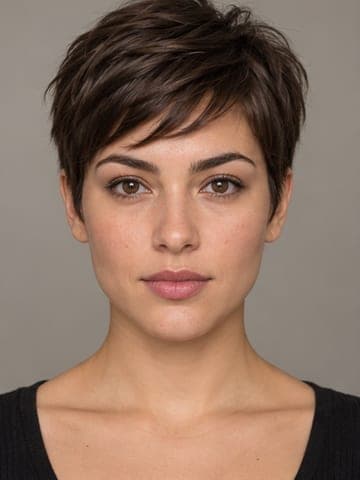
What a pixie cut actually is
The cut is built from a contrast between a very short back and sides and a longer top section. How short varies: some versions taper to skin at the nape, others keep a centimetre or two all round. The top is normally between four and eight centimetres, which is enough to push forward into a fringe, sweep to one side, or lift for volume.
Because so little hair remains, the shape of your skull is visible in a way it never is at longer lengths. A good stylist will cut to it — leaving more length over a flat spot at the back, taking more off where the head is already round. This is why a pixie that looks excellent on one person can sit oddly on another with the same face shape.
There is no hemline to hide behind, so the cut is either precise or it is not. Expect more time in the chair than a trim on long hair, and expect the stylist to check the outline from several angles rather than working from the front.
How it differs from the cuts people confuse it with
| Shaggy pixie | A shaggy pixie keeps the same short back but leaves the top choppy and longer, so it reads softer and needs less precision as it grows. |
|---|---|
| Undercut pixie | An undercut pixie removes the sides to a single short guard with a hard disconnection. The classic pixie blends from short to long instead. |
| French bob | A French bob is the next step up in length, covering the ears and the nape. If you are unsure about a pixie, this is the usual halfway point. |
Who it suits
The common claim is that pixies need good cheekbones. What they actually need is a neck and jaw you are happy to show, because the cut removes everything that was covering them. Oval, heart and diamond faces are the easiest, since the width at the cheekbone already balances a short, close shape above it.
Fine hair does unusually well here. At four to six centimetres, fine hair stands up and holds a direction that it cannot manage at any longer length, so a pixie often looks thicker than the long hair it replaced. Thick hair also works but needs internal weight removal, otherwise the top section sits as a solid block rather than separating.
Hair that grows forward at the nape, or a strong crown whorl, changes the plan more than face shape does. A crown whorl in particular decides which way the top can be styled — fighting it daily is the single most common reason people give up on a pixie.
When not to pick it
- You are not prepared to visit a salon every four to six weeks. A pixie loses its shape faster than any other cut, and the grow-out is visible within a month.
- You rely on tying your hair back. Nothing is reachable for the best part of a year.
- You have a strong crown whorl you dislike. At this length it determines the styling direction and cannot be hidden.
- You are undecided. This is the one cut on this site where the grow-out is measured in seasons, not weeks — try it on a photo first.
What to say in the chair
Naming the landmark and the length is what makes the request land.
- Say how long the top should be in centimetres or inches: "about five centimetres on top" is unambiguous, "short but not too short" is not.
- Say how short the sides go, and whether you want them blended or disconnected: "taper the sides, no hard line" versus "keep a clean disconnection".
- Say which direction you style the top: forward into a fringe, swept to one side, or lifted. The cut differs for each.
- Ask them to look at your crown before starting, and to tell you which direction it wants to sit.
- On a first pixie, ask for the top to be left a centimetre longer than the photo. It can come off next visit; it cannot go back on.
Terms worth knowing
- Taper
- A gradual shortening down the back and sides with no visible step. The default for a classic pixie.
- Disconnection
- A deliberate hard line between the short sides and the longer top. Sharper, more fashion-led, and harder to grow out.
- Crown whorl
- The spiral at the back of the crown where hair changes direction. At pixie length it dictates how the top can be styled.
- Weight line
- The level where the hair starts to sit flat against the head. Raising it creates lift; lowering it makes the shape rounder.
Upkeep
| Styling time | 3–5 minutes |
|---|---|
| Back to the salon | 4–6 weeks |
| Effort | 2/5 · Low effort |
| What you need | A matte paste or clay · A hairdryer, for lift at the roots |
Daily styling is quick but rarely skippable. A small amount of matte paste worked through dry hair with your fingers sets the direction in a couple of minutes. Most people also give the roots thirty seconds of heat to lift the top section, because a pixie that lies flat loses the contrast between the short sides and the longer top.
The trade-off for low daily effort is high salon frequency. Four to six weeks is the real interval; past eight weeks the sides grow into the top, the outline softens, and the cut starts reading as an unintentional short crop. Budget for this before committing, because it is the cost most people underestimate.
Ways it gets cut
The same name covers several shapes. These are the ones worth naming at the salon.
Long pixie
Seven to eight centimetres on top and the sides left long enough to tuck behind the ear. Much easier to grow out and far more forgiving between appointments, which makes it the sensible first pixie.
Undercut pixie
The sides taken to a single short guard with a deliberate hard line against the longer top. Sharper and more fashion-led, but the disconnection makes the grow-out noticeably more awkward.
Curly pixie
Cut dry so each curl is placed individually, with the shape coming from curl pattern rather than from a precise taper. It needs less frequent cutting than a straight pixie because the outline is meant to be irregular.
What it costs
The cut itself is quick but skilled, so it is not the cheap option people expect. The real figure is the frequency: at four to six weeks you are booking nine to twelve appointments a year. Many people buy clippers for the nape between visits, which stretches the interval by a couple of weeks.
Colours that suit it
Before and after, same photo
Same photo, same light, hair only. Nothing about the face, jaw or neck was retouched — which matters for this cut specifically, because the jaw and neck are what a pixie exposes.

 BeforeAfter · Pixie cut
How we build these previews
So you know what you are comparing.
We built all 65 cuts in this library — 40on the women's reference model and 25on the men's — from 2 base photographs, one per model, rather than collecting 65 unrelated pictures. Every preview is an edit of that single base photo, so the face, skin texture, pose, clothing, background and lighting are identical across the whole library. The only variable is the hair.
Our method is deliberately constrained: the edit instruction forbids smoothing skin, slimming the face or changing the eyes, because a flattered “after” would make the comparison worthless. That is why the pixie cut above can be read against any other cut here — same person, same light. The before-and-after pairs come from one photograph for the same reason, and when you upload your own picture we use that same pipeline, not a different one.
For the fit advice we measure the same way our face shape detector does: 478 facial landmarksread in your browser with Google's MediaPipe Face Landmarker, then compared against 7 reference shapes on fixed ratios — a length-to-width ratio of 1.6 or more reads as oblong, under 1.3 reads round or square, and a jaw at 92% of cheekbone width or wider reads as square. Nothing is uploaded for that step; it runs on your device.
What this cannot tell you:how your own hair will behave once it is cut. Density, growth pattern, cowlicks and the stylist's hand all change the result, and no preview predicts them. Plenty of faces also sit within a percentage point or two of those thresholds, so a small change in head angle can move the reading — treat the fit advice as a shortlist, not a verdict, then take the shortlist to a salon.
Updated November 2026. We revise a cut's page when the advice or the renders change, not on a schedule.
Pixie cut questions
Does a pixie cut suit a round face?
It can, but the top needs height and the sides need to stay close. A flat, rounded pixie on a round face repeats the shape; lift at the crown counteracts it.
How long does it take to grow out a pixie?
Roughly a year to reach a chin-length bob, assuming about a centimetre a month. The awkward phase is months three to six, when the sides reach the ears.
Is a pixie cut good for fine hair?
Yes, unusually so. At four to six centimetres fine hair stands up and holds a direction it cannot manage when longer, so the result often looks thicker than the long hair it replaced.
How often does a pixie need cutting?
Every four to six weeks. It loses its outline faster than any other cut, and this is the cost most people underestimate.
Can I get a pixie with thick hair?
Yes, with internal weight removal so the top separates instead of sitting as a block. Say you want weight taken out from the inside, not off the outline.
What is the difference between a pixie and a crop?
They overlap. A crop generally means a shorter, blunter top worn forward; a pixie usually keeps more length on top and is styled in a direction.
Will a pixie work with curly hair?
Yes, as a curly pixie. It is cut dry so each curl is placed, and the shape relies on curl pattern rather than on a precise taper.
Does a pixie make you look older?
Nothing about the length does that on its own. What ages a short cut is a flat, set shape; keeping the top soft and slightly undone avoids it.
How do I know if a pixie suits my head shape?
Upload a front-facing photo to the hairstyle changer and pick the pixie. Because only the hair changes, you are judging it against your own jaw and neck.
What should I do while a pixie grows out?
Keep cutting the sides and nape every six weeks while letting the top run. That holds a deliberate shape through the months when the sides reach the ears, which is the stage most people find hardest.
Related cuts
See the pixie cut on your own face
Upload one front-facing photo. Your face stays yours — only the hair changes.
Try it free